Have you ever been annoyed when you have to send an important message to someone and your computer is acting up? Or your cell battery dies just when you need to send an important text? Frustrating, for sure!
So imagine what it must be like for someone waiting more than 20 years to communicate his needs, feelings and thoughts, locked inside his mind by a faulty connection between his brain and body.
The disconnect is still there, but the lock is now open. Chris Dodd can’t use his voice, but his words are clear, expressive, and intelligent.
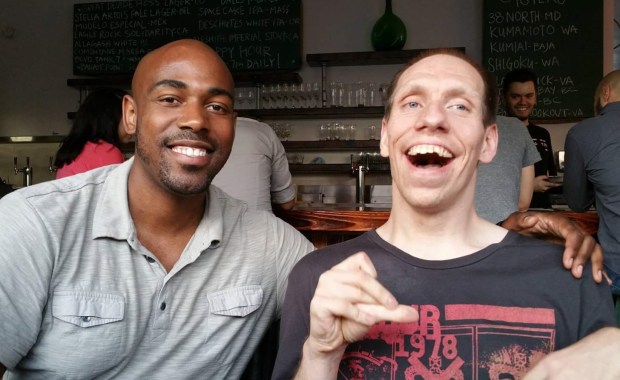
Masai and Chris
The Wrong Key
As a child, doctors diagnosed Chris with global developmental delay, or delays in several different areas. He could not speak and had poor control of his physical movement, manifested similarly to cerebral palsy. He was given little hope of communicating beyond the sounds and movements that indicate basic needs, and no one really knew his level of intelligence.
He was enrolled in various programs such as AchieveKids, which teaches non-verbal children to communicate using pictures, but had limited success. As he grew physically, so did his isolation and his understanding that he was different. “It was sad because I was teased a lot,” Chris told me, “but I had my family and friends.” He took anti-anxiety medication to help ease the stress.
In his early 20s, Chris went to see a different neurologist, who told Chris’s mother, Kim, that he clearly has autism. “We were very surprised,” said Kim. “It was the first time anyone had ever made that diagnosis and it changed the way we thought about how we could help him.”
Shortly before his 21st birthday, Chris moved into his own apartment. “I needed my own place,” he said. “It was time to leave the nest.” His family’s home had grown very busy and was a bit overwhelming for him. His first live-in caregiver was a family friend, who made it easier for Chris to make the transition into a quieter apartment that better met his sensory needs.
The Right Key
When Chris was in his mid-20s, Kim, who is the founder and executive director of Trinity CHANGE, Inc., a supported living services agency in San Jose, CA, discovered the key to unlock Chris’s communication during a meeting with a non-verbal client. He used a technique called supported typing to communicate, and Kim hired an expert to teach the technique to Chris and his caregivers.
By the end of the first session he was communicating… for the first time in his life!
I interviewed Chris at his apartment and, as a father of autistic kids, I was surprised by the difficulty he had controlling his movements. Kim explained that Chris has a “disorganized body” as the result of his autism. Basically, that means there is a lot of static in the connection between his brain and his body. When his brain sends a signal for his body to move, the message is garbled and his body can’t always do what he wants.
Turning the Key
He needs physical touch to “organize” his body, explained Kim, meaning he needs someone to apply a bit of pressure so he can better control his movements. During the interview, Masai Davis, Chris’s primary live-in caregiver, sat next to Chris, who sat in front of his type pad, a laminated page with the alphabet, propped up on a small easel. After each question, Masai would lightly hold Chris’s right arm as Chris attempted to touch the letters to form his words. That pressure helped Chris target the letter more accurately, but it was often still a struggle.
Masai, who has worked with Chris for nearly five years, gently provided physical and verbal support when Chris lost focus or control. Sometimes it took several minutes for him to complete a word. Knowing how long it took Chris to share his first words, I was happy to wait.
With his voice unlocked, everything began to change for Chris. As his communication skills grew, so did his world. He soon was off the anti-anxiety medication.
Besides Masai, there are typically 2-4 other caregivers who come in part-time to ensure around-the-clock support for Chris. Finding and keeping good staff is the hardest part about living alone, says Chris. “They don’t get paid much and I get attached to them. I just lost two good staff,” he said. “These days are really rough.”
But when I asked him what he would change, if he had the opportunity, he said, “Nothing. I have a great life.”
About me: I am Pete Resler, a dad of two boys with special needs. I created this blog to tell stories of incredibly good people, including those with special needs and those who give of themselves to make life better for them. My hope is that these stories expose more people to what’s good in the special needs world and inspire them to give of themselves to make life better for those with special needs.
You can help: I’m always looking for new ideas. If you know someone you think should be featured, shoot me a note at specialopstories@gmail.com.
 Special Ops
Excellent story.
LikeLike
This is an amazing story.
LikeLike
Thank you for this story. Chris is my nephew and has come a long way. So glad he can communicate. What a game changer. Or should I say life changer.
LikeLike
Thank you, Mary. Chris is an inspiration to others to never take never for an answer.
LikeLike
Pete,
Your blog site is very, very well done. I’m sure there is much more behind the “Unlock My Life” story that can’t fit into a blog type format. I hope Chris continues to have the means to fund his care givers.
I hope all is well out in California. Please tell the family your friends in Illinois say “hi” and “Happy Easter!”
Cheers!
LikeLike
Thank you, Clark! Happy Easter to you, Kelly and Olivia.
LikeLike
Nice piece….And an inspiration on a day when I needed one! Best of luck for continued success to Chris!
LikeLike
Thank you!
LikeLike
Great stories Pete! You have a great way of writing! The emotion compassion and positivity shine thru! Very inspirational! Keep up the good work and inspiration!!!!
LikeLike
Thank you, Bernard
LikeLike
Another excellent and inspiring story Pete. Thanks for posting.
LikeLike
Thanks, Kevin
LikeLike