developmental disabilities

ArtThread Making a SPLASH! in Special Needs Community

I am a writer. I string words together to communicate information, persuade, amuse. I express my creativity by thoughtfully using language to paint vibrant pictures and performances in your mind, making you feel, think, react. It is my art. When I write I am filled with light.

For people with special needs, their ability to communicate, to express their feelings, to ask for help, to explore what is possible are often stymied by physical or mental limitations. Without an expressive outlet, their inner light is burdened by darkness. They can’t easily find a way out, so they may never become their best selves.

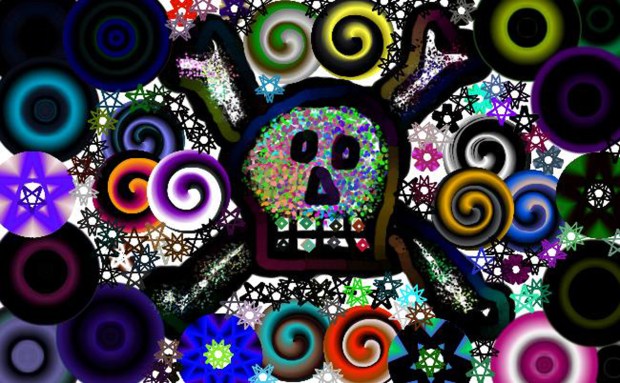
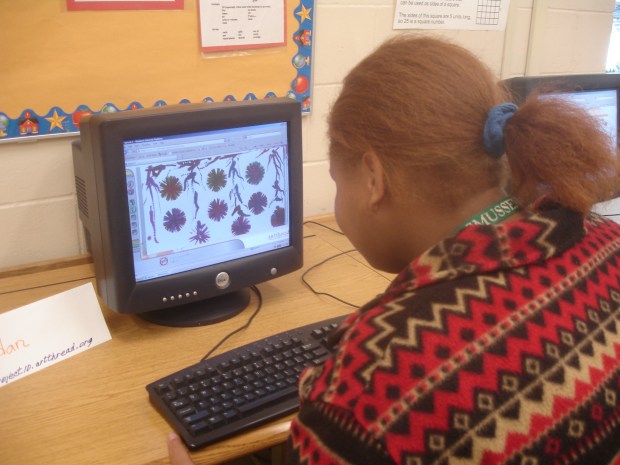
Art can be the switch that fills the darkness with light, and Jay Klein (founder and CEO) and Rob Rothschild (president) of the ArtThread Foundation, are making artistic expression easy and accessible with an online art program centered on a “digital Etch-A-Sketch” tool called SPLASH! And it is doing wonders for people of all ages who had been limited by their own minds, bodies, or environments.
student

Try SPLASH! It’s free! Just set up an account and click “Create Art Online.”

“Our mission is to make art and creative expression more available to everyone, especially those impacted by social circumstance and physical limitations,” says Jay. Through the ArtThread Foundation, teachers are using SPLASH! in schools across the country to help children learn, express themselves, vent their frustrations, discover their creativity, and build self-esteem. “This is an adaptive technology that enhances success for students with disabilities,” says Jay.

The Power of Expression

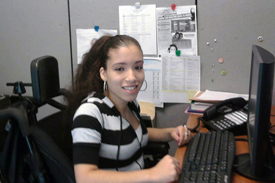
Alonna had the opportunity to try SPLASH! when she was in her early 20s, shortly before aging out of the Florida school system. She lives with spina bifida, a spinal birth defect that affects her ability to walk and learn. She made it through high school in St. Petersburg and entered a transition program called Project 10 to prepare for living in the adult world. Project 10 is an ArtThread “pARTner” and uses the program to help students explore their artistic side.

“She really took to it in a special way,” says Rob Rothschild, president of ArtThread Foundation. Alonna was one of  a small group of Project 10 students who were selected to participate in Work of Art (WOA), an ArtThread program that teaches participants how to turn their love of art into an online business.
alonna_torres

Alonna in her SPLASH! studio

Developed in conjunction with VSA Florida and funded with a grant from The Able Trust, WOA helps students set up e-commerce businesses through which they can sell products featuring their original art. Through a custom portal to the online marketplace Zazzle, the artists create and sell shirts, coffee mugs, and other items featuring their work.


Rob showed Alonna how to set up and manage her store and design products on the Zazzle platform. “Alonna was very shy,” says Rob. “Learning how to create art and sell it in her own online store really boosted her confidence. She really took to it in a special way.”

“I love to paint and draw and be creative,” she wrote after launching her online store. “When I do art I am free from all the challenges that I face on a daily basis.”

How It Began

The initiating concept for ArtThread was born from Jay’s National Institute of Health, National Cancer Institute, and U.S. Department of Commerce funded research at the University of Florida. “I was studying the effects of artistic expression on symptom management in children undergoing cancer treatment,” says Jay. “I found that they had a better quality of life because they found meaning in the art. People who are more resilient have been able to attach positive meaning to their journey. That positivity displaces the negativity of their circumstance.”

“Then it dawned on me that it could help people with disabilities as well,” he says. “That’s when we came up with the idea to create the ArtThread Foundation as a way to develop the tools and partner with organizations that would benefit from it.”


“Any place there is no darkness there is light.”


Jay used the power of creative expression as a survivorship tool himself when he battled and beat cancer as a young man, and he is passionate about using technology and creative expression to foster self-esteem and community among children with disabilities, health challenges, and difficult social circumstances. The foundation partnered with Carnegie Mellon University to develop SPLASH! and the platform for the online art galleries.

Amazing Results

ArtThread has taken root in Florida with organizations serving people with special needs such as VSA and Project 10, and in Sonoma County, CA, with the Early Learning Institute. It is also used at the Shriners Hospital for Children in Tampa, FL, where young patients can create art with SPLASH!, providing a way to express themselves and bring light into their lives.

At VSA, Bonnie Hammer is a teaching artist implementing the program in schools in and around Sarasota, FL. Special education teachers apply for grants through VSA to implement an 8-week program. At the start of each program, she works with the teacher to use the online art tools to enhance the curriculum, whether it’s learning colors and shapes, combining shapes to build things, or learning math and science.

“It’s like a giant coloring book,” says Bonnie. “Once the students see me using it, they get very excited and want to try it.” The program also helps students develop fine motor skills and can help students focus, relax, and express their feelings. “I’ve even used the program with young offenders in a juvenile prison,” she says. “They have a lot of anger and other issues, and through the creative process they’re able to work through them.”

wow

ArtThread opens limitless possibilities for people of all abilities.

Karen Holtman tested ArtThread with kindergarten students at John B. Riebli Elementary School in Santa Rosa, CA. “Jay asked me to collect data to document how effective the program was with 5-year-olds. It had only been used with older children and adults, so he was skeptical it would be successful.”

“It was extremely popular with the kids,” says Karen. ArtThread provided the hardware for three SPLASH! stations in her classroom! She used it to teach the children colors, shapes and patterns. She paired them up and had them copy what one another created, teaching them how to work together. “It really helped lay the foundation for using technology in a fun way.”

Turn on the Light

Jay and Rob would love to see ArtThread in every school, particularly those that have eliminated the arts because of budget constraints, so students can use art to discover their abilities and unlock their full potential.

“When you remove art, you remove not only an individual’s ability to express himself, but you also remove a society’s ability to express itself,” says Jay. “Creativity is a key part of our wellness.”

If you would like to begin a program in your school or organization, contact ArtThread to become a “pARTner.”

You will be amazed at how quickly the light chases away the darkness.

About me: I am Pete Resler, a dad of two boys with special head and shouldersneeds. I created this blog to tell stories of exceptional people, including those with special needs and those who give of themselves to make life better for them. My hope is that these stories expose more people to what’s good in the special needs world and inspire them to give of themselves to make life better for those with special needs.
You can help:  I’m always looking for new ideas. If you know someone you think should be featured, shoot me a note at specialopstories@gmail.com.
A Creative Heart

Like anyone, Jenny Unrein has her ups and downs. “I like to draw and make people happy,” she says, but “I don’t like people staring.”

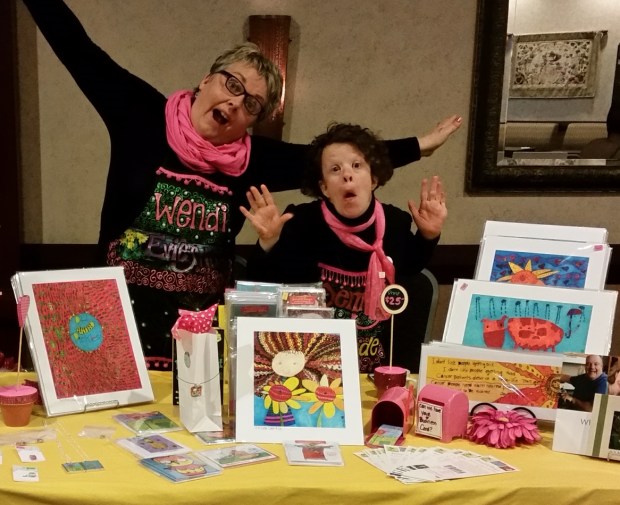
Jenny is the 27-year-old artist behind JennyLU Designs, an original art business in Topeka, Kansas, that she co-owns with her step-mother, Wendi Unrein.  Born from a desire to help others, the business is doing well, but it’s not easy.

Sure, any business will go through ups and downs, but Jenny is not just any business owner. She has Williams syndrome (WS), a rare genetic disorder related to the absence of several genes in the 7th chromosome. People with WS have developmental delays, health issues, and distinctive facial features, sometimes referred to as “elfin”, thus the frequent staring.

JennyLU Wendi and Jenny

Wendi and Jenny clown around at the JennyLU Designs booth.

Inspiration

“I used to make cards for my mom and for other people to make them feel good,” says Jenny about her life-long love of drawing. Cats and dogs, hearts and flowers are her favorite subjects.

“The thing that caught me was that her drawings were so passionate,” says Wendi, an artist and art teacher. She noted that Jenny rarely draws just to draw: “For her to do art, it has to be for a purpose, for someone else.”

“One day I asked her to draw a picture with a Sharpie, then I colored it in. It was very cute,” says Wendi. That first collaboration grew into a fun activity for them both.

JennyLU program cover

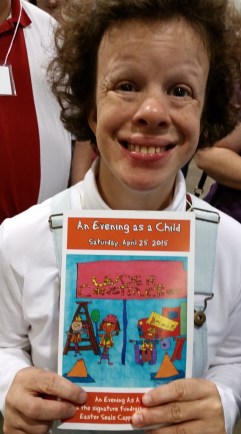
Jenny with the Topeka Easter Seals Capper Foundation program, featuring her original artwork

“One day I was watching Oprah and I saw a girl who had a lemonade stand to help people with cancer, and I wanted to do something to help, too,” says Jenny. So she and Wendi decided to create pictures to donate to fundraiser auctions.

“We took some of the pictures to Jenny’s school and the teachers bought all of them,” Wendi said. “That’s when I realized people would actually pay for Jenny’s pictures.” And JennyLU Designs was born.

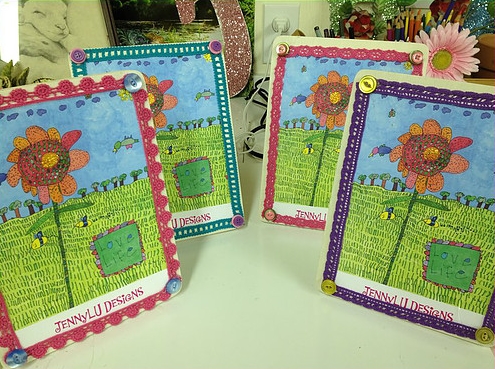
That was eight years ago and since then the pair has traveled around the country to conferences and art shows where they sell prints, called “Jennydoodles”, and a variety of other products featuring Jenny’s art, such as note cards, jewelry and calendars. The products are also available on the JennyLU Designs website.

But it’s not always easy for Jenny. She struggles with anxiety, common among people with WS, and it’s often hard to keep her motivated to create new pictures. “Jenny really likes going to the conferences, so when she knows there is one coming up, she stays motivated,” says Wendi.

“We do well at conferences related to disabilities,” says Wendi, giving all the credit to Jenny. One of the most noticeable traits of people with WS is their social, endearing personality. They are very personable, caring, and aware of others’ feelings. “When they see Jenny, they buy,” says Wendi.

And Jenny has become a popular speaker at those conferences, as well, delivering workshops on owning a business and educating others about Williams Syndrome.

JennyLU plaques

Whenever they meet someone with cancer at a show or convention, Jenny and Wendi give that person a Love Life plaque as a show of support.

Art for good

But Jenny has remained true to her original motivation, regularly donating her artwork to a variety of non-profits, both locally and nationally, such as the American Cancer Society. “If I see someone with cancer, I think it’s important to help them. It makes me sad,” says Jenny.

She also creates the cover artwork for the program at the Easter Seals Capper Foundation annual fundraiser in Topeka and donates artwork for the auction. “We donate to a lot of the organizations that help our kids,” says Wendi. In 2015 they also began donating proceeds from card sales to St. Jude Children’s Research Hospital.

People love Jenny’s work so much many have commissioned original works, some from overseas. Her work has also hung in the White House and the Kansas State House.

“My favorite part is seeing people’s reaction to my artwork,” says Jenny. “I love having the business because I’m making a difference.”

Having the business has also made a big difference for Jenny, giving her confidence and purpose. “It doesn’t matter what kind of disability you have,” she says, “you can run a business.”

head and shouldersAbout me: I am Pete Resler, a dad of two boys with special needs. I created this blog to tell stories of exceptional people, including those with special needs and those who give of themselves to make life better for them. My hope is that these stories expose more people to what’s good in the special needs world and inspire them to give of themselves to make life better for those with special needs.

You can help:  I’m always looking for new ideas. If you know someone you think should be featured, shoot me a note at specialopstories@gmail.com.
ENN: An Exceptional Experience

In the summer of 2007, 15-year-old Remington Fox walked onto the grounds of Camp Arroyo near Livermore, CA, literally terrified of what he was walking toward. His mother had nudged him to volunteer at a camp for youths with special needs and he was not happy about it.

“My parents heard that this camp was looking for volunteers, so my mom got me an interview. I wasn’t interested at all. I was really intimidated. I didn’t know anything about people with special needs,” he says. “But they thought it would be good for me, so I did it.”

Fast forward to November 2015: My nearly 15-year-old son Christian (heretofore “C”) walked onto the grounds of Camp Arroyo for his first residential camp, a 2-night, 3-day stay only 40 minutes from home. He wasn’t at all terrified, but rather was ready to cut loose without Mom and Dad, fearless as always and eager for Mom to head home.

My wife, Sarah, had camped out most of one night the previous spring to get one of the last slots at the uber-popular Exceptional Needs Network (ENN) camp. After checking in, C met his personal camp counselor, the one and only Remington, who by then was one of the most experienced counselors there.

ENN Remington & C

Christian and Remington

“I volunteered that first summer and fell in love with it,” says Remington. “It really changed my perspective on kids with disabilities.” He’s worked every camp session (three per year) since that first one, and he plans to do it as long as he can. “It’s like a vacation for me. It resets me on what’s really important.” C now feels the same way, about the vacation part anyway.

A Little History

“When my son was young, I needed to find something for him to do outside of school, especially during the summer,” says Valerie Hund, one of the founding mothers of ENN and the current board president. There were no activities available in the Livermore area for kids on the autism spectrum, like Grayson, who need a level of structure and understanding that traditional programs don’t usually provide.

“At that time there was only one after-school program in the area for kids with special needs, but nothing during the summer,” she says. In 2001, she was introduced to another mother with similar concerns, and before long they had formed a small group that eventually became ENN.

They wanted to establish a camp to give the kids an opportunity to enjoy outdoor activities and, equally importantly, give the parents a well-deserved break. “That’s what is different about us,” says Laura Peters, ENN’s camp director. “The other special needs camps in this area are all family camps. Ours is a respite camp just for the kids. As important as it is for the kids to have their own experience, it is also very important that the parents get a break.”

By the next summer, the group had organized its first camp for a small group of children, mostly the children of board members and their friends.

They were fortunate to get access to Camp Arroyo, which the Taylor Family Foundation helped established in 2000 with the East Bay Regional Park District. Operated by YMCA of the East Bay, Camp Arroyo hosts a variety of camps for children with life-threatening and chronic illnesses, developmental disabilities, and youth-at-risk.

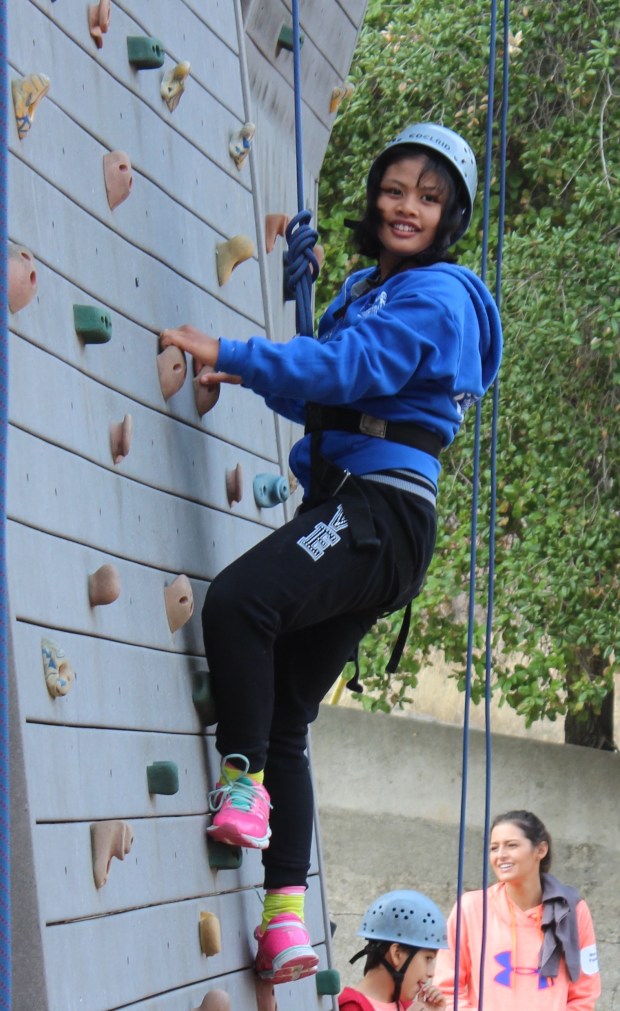
ENN climber

Chelsea tackles the climbing wall at Camp Arroyo.

An Awesome Camp Experience

ENN has three camps there each year, two in summer and one in the fall. Campers take part in a wide variety of activities, regardless of their disability, including swimming, zip-lining, a climbing wall, arts and crafts, and other fun activities.

The 45 slots per session fill up quickly every spring, so if you’re not in line in the wee hours before sunrise on registration day, you might be out of luck.

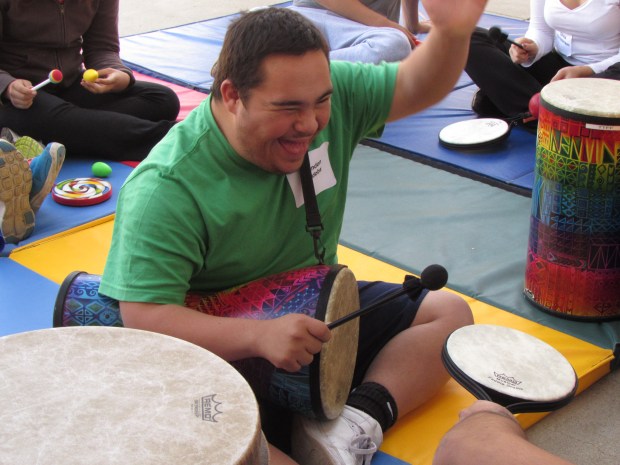
ENN drummer

Brandon keeps the beat.

Exceptional Staff

Remington’s experience is common, first volunteering as an activity aide until turning 18, then becoming a counselor, assigned to one camper for the duration of camp. It’s not 9-to-5, but around the clock from the time the camper arrives until he leaves 3 or 4 days later. And sleep is not guaranteed; ask Remington, who spent many late night hours with C in the aptly named “Up All Night” cabin.

“When I started (as a counselor), they gave me the easier kids,” he says. “Now that I’m more experienced, they often assign me kids that need a little extra help.” He made a strong connection with his very first camper, Ryan, who comes back every summer and requests Remington as his counselor. “He’s my buddy,” says Remington. “We talk throughout the year and even get together for lunch sometimes.”

The counselors are paid, but for most it is a labor of love. “We think it’s really important to have the best staff and we’ve done whatever we needed to do to be sure we could pay them,” says Valerie.

Making Ends Meet

“We rely a lot on fundraisers throughout the year, but a lot of that money dried up during the recession. At the end of our camps in 2009, many of the staff gave some or all of their pay back to help us stay afloat.”

While parents do pay a nominal registration fee, there is no fee to attend camp. To offset the $20,000-plus cost to operate each camp session, the all-volunteer ENN board conducts fundraisers throughout the year, individuals donate or raise funds specifically for ENN, and parents are encouraged to submit a request for funding to their Regional Center for their camp session.

And, of course, donations are always welcome.

ENN zipline

Josh flies on the zipline.

Making Memories

Each camp session ends with a talent show and awards ceremony with specific recognition for each camper. C earned “The Steph Curry Basketball Award” for his MVP-like moves and his deft touch with the roundball.

Sarah, along with the other parents, attended the final event, but, knowing that meant the end of camp, C did not hide his displeasure when he saw her.  As disappointed as he was to have to go home, he is now looking forward to his next camp, this time in the summer with the chance to swim, his second favorite activity after bowling.

Remington, who is a new college graduate and an aspiring children’s book author, will be back as well. “They say Disneyland is the happiest place on Earth, but I think it’s ENN camp. It’s special. It really is a wonderful place.”

head and shoulders


About me: I am Pete Resler, a dad of two boys with special needs. I created this blog to tell stories of exceptional people, including those with special needs and those who give of themselves to make life better for them. My hope is that these stories expose more people to what’s good in the special needs world and inspire them to give of themselves to make life better for those with special needs.

You can help:  I’m always looking for new ideas. If you know someone you think should be featured, shoot me a note at specialopstories@gmail.com.
Don’t Dis My Abilities! Help Them Shine!

“I found I could say things with color and shapes that I couldn’t say any other way – things I had no words for.”  – Georgia O’Keeffe

Artists have a special gift that often lies dormant until someone provides encouragement and opportunity, allowing it to fully blossom. Be it painting, dancing, writing or film-making, creativity needs inspiration and an outlet to release expression, regardless of a person’s physical voice.

DeAnna Pursai and Pam Lindsay have opened that door for adults with disabilities by founding the College of Adaptive Arts (CAA) in San Jose, CA. There students have a unique opportunity to express themselves like they never could before thanks to a dedicated team of professionals who are building a true college experience for people who don’t have a place in a traditional college classroom.

CAA hiphop

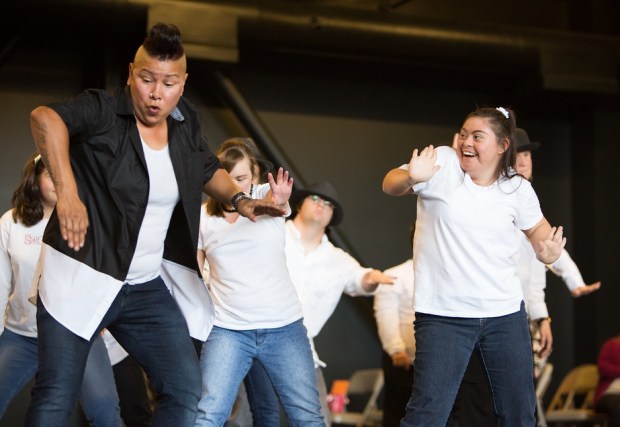
Professor Isabella Torres and dance student Renee show their hip-hop moves during the 2015 graduation ceremony. Photo courtesy of Linda Krakow Eaman.

A Better Option

“When people age out of the special education system as young adults, there aren’t many programs for them,” said DeAnna, who serves as executive director and is a public school teacher. “We wanted to provide an environment where they can explore and expand their abilities, not sit in a day program for the rest of their lives because of their disabilities.”

She hatched the idea while running a non-profit theater program for children with disabilities, called Angels on Stage, named for her sister, Angel, who has Down syndrome and acted in a similar troupe as a child in Indiana.

There she met Pam, whose daughter performed with the troupe. With a professional background in acting and other performing arts, she began directing the troupe. She soon saw the need for a similar program for disabled adults and began running an acting workshop for them.

Pam had also been homeschooling her daughter, Val, using theater and music to help Val learn, and was also completing a master’s degree in theater arts with a focus on how techniques used in teaching character acting can be effective in teaching social cognitive skills to autistic children.

CAA founders

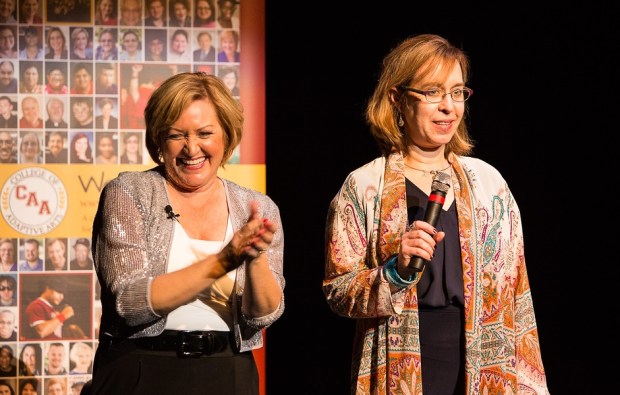
CAA co-founders Pam Lindsay and DeAnna Pursai. Photo courtesy of Linda Krakow Eaman.

Going Live

With DeAnna’s experience in special education (she still teaches part-time) and running a non-profit, and Pam’s arts and education expertise, they launched CAA in 2009, renting a small space at a dance studio for their first 12 students. Seven years in, CAA has moved around a bit as discounted spaces are lost and new ones found, all the while growing to more than 70 students today.

They enjoy eight different courses of study, learning dance, vocal and instrumental performance, TV and film production, fine arts, and a variety of other courses in the arts and other educational disciplines and life skills.

And like traditional universities, CAA offers low-cost bachelor’s and master’s degree tracks in each discipline. The standards and accreditation are unique to CAA, but that fits its unique community perfectly. And so does the staff, more than half of whom also have a disability.

Life is a Stage

Performers and artists learn their craft in the classroom, then, like other professionals, take to the public stage, screen and gallery to share their art with the masses. Performance groups, such as the graduate theater troupe, perform for local children, while TV and film students produce a TV show and debut their short films at the annual Celebrating Differing Abilities Film Festival.

Several aspiring actors even had the opportunity to participate in a professional-style audition before some of the top professionals in Bay Area theater through a partnership with City Lights Theater in San Jose. Students experienced it all, from preparing their resumes, complete with professional photos, to rehearsing, performing and receiving feedback from the panel.

“It was really a great experience for the students to feel the pressure and excitement of a real audition,” said Pam. “But it was also a real revelation for the professional judges, who now view our actors as legitimate members of the theater community.”

CAA Carlos & Nathalie

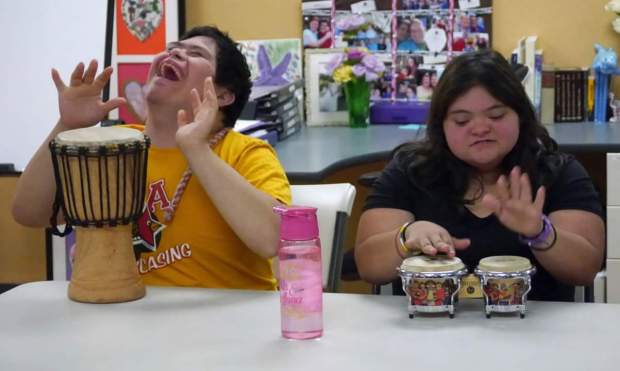
Carlos and Nathalie keep the rhythm during one of many music classes at CAA.

Student Ambassadors

When it comes to selling the school, the students are the secret sauce. “Every time someone tours the college or the students go out and perform, we win at least one more heart,” said DeAnna. “We’re not a day care; our students want to be here to learn, create and contribute, and it shows in their enthusiasm.”

When it came time to find the space the college now occupies, it was a student who sold the property owner on providing the space at a discount. But with that discount comes the possibility that CAA will lose that space if someone else is willing to pay full price. “We’ve had times when we’ve lost our space and had to scramble to find places to hold our classes,” she said. “We’re very fortunate and thankful that we have this space, but we are always looking for a permanent place to call home.”

Growing on a Permanent Foundation

Their goal is to find an area college that will welcome CAA as a charter school on campus, providing a permanent home and giving students a real campus where they can utilize more resources and mingle with typical peers.

“Once we have a more permanent location, we’d like to grow into other markets to provide opportunity to adults with disabilities in other parts of the country,” said DeAnna. They have also submitted a grant application to fund the technology they need to provide distance learning for people who are physically unable to get to campus or live in other parts of the world.

Stay Tuned

The story of CAA is rich and evolving, with students, professors and volunteers all working to build a community where adults with special needs can learn, grow and express themselves as they want. It’s all too much to tell in a single post, so stay tuned to Special Ops for more stories of exceptional people at CAA!

About me: I am Pete Resler, a dad of two boys with special needs. I created this blog to tell stories of head and shouldersincredibly good people, including those with special needs and those who give of themselves to make life better for them. My hope is that these stories expose more people to what’s good in the special needs world and inspire them to give of themselves to make life better for those with special needs.

You can help:  I’m always looking for new ideas. If you know someone you think should be featured, shoot me a note at specialopstories@gmail.com.
Unlock My Life

Have you ever been annoyed when you have to send an important message to someone and your computer is acting up? Or your cell battery dies just when you need to send an important text? Frustrating, for sure!

So imagine what it must be like for someone waiting more than 20 years to communicate his needs, feelings and thoughts, locked inside his mind by a faulty connection between his brain and body.

The disconnect is still there, but the lock is now open. Chris Dodd can’t use his voice, but his words are clear, expressive, and intelligent.

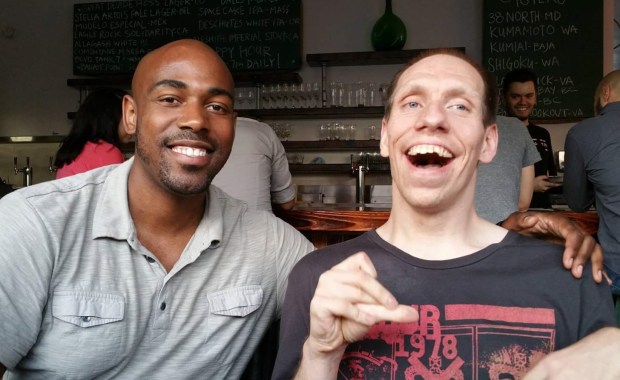
Chris and Masai conference dinner

Masai and Chris

The Wrong Key

As a child, doctors diagnosed Chris with global developmental delay, or delays in several different areas. He could not speak and had poor control of his physical movement, manifested similarly to cerebral palsy. He was given little hope of communicating beyond the sounds and movements that indicate basic needs, and no one really knew his level of intelligence.

He was enrolled in various programs such as AchieveKids, which teaches non-verbal children to communicate using pictures, but had limited success. As he grew physically, so did his isolation and his understanding that he was different. “It was sad because I was teased a lot,” Chris told me, “but I had my family and friends.” He took anti-anxiety medication to help ease the stress.

In his early 20s, Chris went to see a different neurologist, who told Chris’s mother, Kim, that he clearly has autism. “We were very surprised,” said Kim. “It was the first time anyone had ever made that diagnosis and it changed the way we thought about how we could help him.”

Shortly before his 21st birthday, Chris moved into his own apartment. “I needed my own place,” he said. “It was time to leave the nest.” His family’s home had grown very busy and was a bit overwhelming for him. His first live-in caregiver was a family friend, who made it easier for Chris to make the transition into a quieter apartment that better met his sensory needs.

The Right Key

When Chris was in his mid-20s, Kim, who is the founder and executive director of Trinity CHANGE, Inc., a supported living services agency in San Jose, CA, discovered the key to unlock Chris’s communication during a meeting with a non-verbal client. He used a technique called supported typing to communicate, and Kim hired an expert to teach the technique to Chris and his caregivers.

By the end of the first session he was communicating… for the first time in his life!

I interviewed Chris at his apartment and, as a father of autistic kids, I was surprised by the difficulty he had controlling his movements. Kim explained that Chris has a “disorganized body” as the result of his autism. Basically, that means there is a lot of static in the connection between his brain and his body. When his brain sends a signal for his body to move, the message is garbled and his body can’t always do what he wants.

Turning the Key

He needs physical touch to “organize” his body, explained Kim, meaning he needs someone to apply a bit of pressure so he can better control his movements. During the interview, Masai Davis, Chris’s primary live-in caregiver, sat next to Chris, who sat in front of his type pad, a laminated page with the alphabet, propped up on a small easel. After each question, Masai would lightly hold Chris’s right arm as Chris attempted to touch the letters to form his words. That pressure helped Chris target the letter more accurately, but it was often still a struggle.

Masai, who has worked with Chris for nearly five years, gently provided physical and verbal support when Chris lost focus or control. Sometimes it took several minutes for him to complete a word. Knowing how long it took Chris to share his first words, I was happy to wait.

With his voice unlocked, everything began to change for Chris. As his communication skills grew, so did his world. He soon was off the anti-anxiety medication.

Besides Masai, there are typically 2-4 other caregivers who come in part-time to ensure around-the-clock support for Chris. Finding and keeping good staff is the hardest part about living alone, says Chris. “They don’t get paid much and I get attached to them. I just lost two good staff,” he said. “These days are really rough.”

But when I asked him what he would change, if he had the opportunity, he said, “Nothing. I have a great life.”

About me: I am Pete Resler, a dad of two boys with special needs. I created thishead and shoulders blog to tell stories of incredibly good people, including those with special needs and those who give of themselves to make life better for them. My hope is that these stories expose more people to what’s good in the special needs world and inspire them to give of themselves to make life better for those with special needs.
You can help:  I’m always looking for new ideas. If you know someone you think should be featured, shoot me a note at specialopstories@gmail.com.

Future Interruptus

Baby #1

One fall morning in 2000, I received a distress call from my wife who was expecting our first child. A “genetic counselor” had called with the news that a genetic test confirmed that our unborn baby had Down Syndrome. One extra chromosome sent our future into a hard left turn … across traffic … on two wheels … with its eyes closed.

I reacted by sitting silently, freaking out on the inside and wondering just how much our lives would change, or, more accurately, how what we expected life to be like as parents would change. Given the instinctual options of fight or flight, I chose fight. And to be effective I had to know my enemy… so I Googled it.

In hindsight, we feel very fortunate that we knew before he was born. We read all that we could, talked to other parents who went through what we were facing, and we were able to prepare ourselves. Equally important, we were able to prepare our family and friends, so no awkward silences when people visited us in the hospital, no “mongoloid” references from old Aunt Gert, and no grief. It was just as birth should be, filled with joy and celebration.

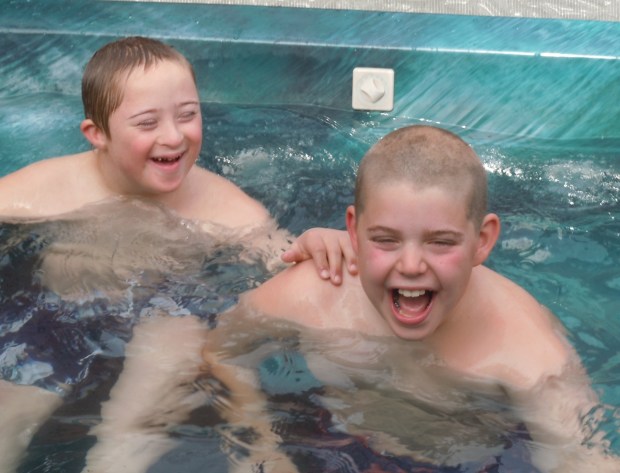
boys in hot tub

Baby #2

Benno came along 30 months later. We didn’t feel the need for genetic testing during that pregnancy. We had only one hope, that he would be healthy, and we felt fortunate that he was born healthy and “normal.” We settled into a fairly comfortable routine.

Warning: Never get too comfortable! It wasn’t long before both boys were diagnosed with autism. Now Mr. Future was in a barrel roll heading for the wall. Over the years, Ben’s list of diagnoses has expanded to include ADD, trichotillomania, and OCD (I know I’m forgetting one or two).  The one that is dominant changes from year to year, month to month, even hour to hour some days.

It’s a daily struggle for them and us, just like it is for every person and family living in the special needs world. Not only do we all deal with the boys’ various limitations, but we also deal with the limited understanding and acceptance of others. That said, things are much better today than they were in the past, when children with disabilities were hidden from the public or, worse, confined in institutions.

The Bright Side

The good news is that today every person, regardless of perceived capabilities, can achieve the unexpected and contribute to society in meaningful ways. By bringing those with the needs and desires, but not the capability, together with those with the capability and the desire to help, perceptions shift toward every person’s unique value, instead of their relative abilities.

This blog is my contribution to that effort. With every post I will share inspiring stories about people with special needs and those who give from their heart, mind and soul to make life better for them. My hope is that “Special Ops” will educate the uneducated, inspire the uninspired, and in some way contribute to the eventual death of “normal” as an adjective.

Follow Along

To stay up to date with the latest and greatest, you can subscribe to the blog by clicking the Follow box at the bottom of the right-hand column on this page, like the “Special Ops” Facebook page (https://www.facebook.com/specialopstories/), or follow the blog on Twitter (@specialopstory).

Thanks for reading. I look forward to sharing this journey with you.

About me: I am Pete Resler, a dad of two boys with special needs. I created thishead and shoulders blog to tell stories of incredibly good people, including those with special needs and those who give of themselves to make life better for them. My hope is that these stories expose more people to what’s good in the special needs world and inspire them to give of themselves to make life better for those with special needs.
You can help:  I’m always looking for new ideas. If you know someone you think should be featured, shoot me a note at specialopstories@gmail.com.