courage

Pigeon Holes are for Pigeons

Michael Criscione was destined to contribute to society as a vending machine attendant, or at least that’s what a government bureaucrat thought he should do. And maybe for others living with spinal muscular atrophy (SMA) that would be just fine, but Michael is not typical.

“I wanted to do something that makes a difference,” said the 33-year-old when we met in Lafayette, CA, to chat and have a beer.

Allow me to put the scene in perspective: When I said we enjoyed a beer, we did, just in our own ways. I drank mine the usual way, while Michael’s attendant poured his directly into his stomach via a port in his abdomen.

Body breakdown

You see, Michael can’t swallow because the muscles that control that process no longer function properly, much like most of the voluntary muscles in his body, including those that help him breathe. SMA is a genetic disorder that results in muscular deterioration and impaired mobility. Michael has Type 2; Type 1 is the most severe. It is a progressive disorder that cripples more and more over time.

He’s in a wheel chair, his movement is very limited, and he has difficulty speaking clearly. His attendant, Christian, had to interpret much of what he said during our discussion. A BiPAP machine aids his breathing. Despite his physical limitations, Michael lives in his own place, but he does require assistance 24/7.

While his body is greatly affected, his brain and his motivation are fully functional. So when the bureaucrat pressed him to do the vending machine work, it’s understandable why Michael felt insulted.
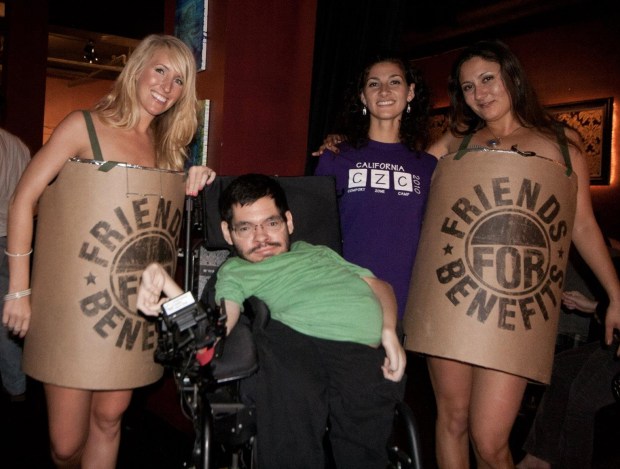
Michael Criscione

Michael Criscione, flanked by Friends for Benefits Barrel Girls Savannah Gray (left) and Pilar Fox, with friend Kim Masdeo

Making his own way

After finishing high school, Michael studied film at the University of California at Berkeley. During that time he started an indie rock band called the Pied Paupers with some of his attendants who were musicians. Michael was the manager, booking shows and getting them some local radio play.

He took his first job as head of fundraising for a non-profit run by a high school friend. He tapped his music network to begin producing concerts for the charity, but the organization eventually folded.

He took that experience and started Friends for Benefits, a non-profit that helps other non-profits by producing fundraising events primarily in the San Francisco Bay area. “I found that most non-profits are great at whatever their mission is, but most of them have no idea how to fundraise,” he said. “There is definitely a need for what I’m doing.”

Since his first music benefit event under Friends for Benefits in 2012, he has organized more than 10 events, more recently focusing on other different genres that bring in more money for the charities. Michael is the organizer, and others help with the details, such as event operations and finance.

With a fully charged wheelchair and an attendant at his side, Michael is constantly prospecting for future events by meeting entertainers and other celebrities at public events around the Bay area, such as shows, fan conventions, and book signings.

Bigger and better

In January, comedian and character actor David Cross (Tobias Fünke on “Arrested Development”) performed his “Making America Great Again” stand-up show at Davies Symphony Hall in San Francisco. Cross generously donated a portion of the proceeds from the evening to Friends for Benefits.

The next event will be “Call Me Lucky: An Evening with Bobcat Goldthwait” (yes, children of the ’80s, that Bobcat Goldthwait) on May 27, 2016, at the Roxie Theater in San Francisco. It will be a screening of “Call Me Lucky”, a documentary directed by Goldthwait about comedian Barry Crimmins, followed by a Q&A.

“We’re not fully established yet,” said Michael, “but we’re doing bigger and better things.” Several other events are being planned, but his dream is to create a week-long arts festival, with a variety of events benefitting several charities. “I want to get Friends for Benefits to a point where we are doing measurable good and I can be fully independent, with no assistance from the government.”

And how likely would that be if he was looking after vending machines?

About me: I am Pete Resler, a dad of two boys with special needs. I created this blog thead and shoulderso tell stories of incredibly good people, including those with special needs and those who give of themselves to make life better for them. My hope is that these stories expose more people to what’s good in the special needs world and inspire them to give of themselves to make life better for those with special needs.
You can help:  I’m always looking for new ideas. If you know someone you think should be featured, shoot me a note at specialopstories@gmail.com.
Unlock My Life

Have you ever been annoyed when you have to send an important message to someone and your computer is acting up? Or your cell battery dies just when you need to send an important text? Frustrating, for sure!

So imagine what it must be like for someone waiting more than 20 years to communicate his needs, feelings and thoughts, locked inside his mind by a faulty connection between his brain and body.

The disconnect is still there, but the lock is now open. Chris Dodd can’t use his voice, but his words are clear, expressive, and intelligent.

Chris and Masai conference dinner

Masai and Chris

The Wrong Key

As a child, doctors diagnosed Chris with global developmental delay, or delays in several different areas. He could not speak and had poor control of his physical movement, manifested similarly to cerebral palsy. He was given little hope of communicating beyond the sounds and movements that indicate basic needs, and no one really knew his level of intelligence.

He was enrolled in various programs such as AchieveKids, which teaches non-verbal children to communicate using pictures, but had limited success. As he grew physically, so did his isolation and his understanding that he was different. “It was sad because I was teased a lot,” Chris told me, “but I had my family and friends.” He took anti-anxiety medication to help ease the stress.

In his early 20s, Chris went to see a different neurologist, who told Chris’s mother, Kim, that he clearly has autism. “We were very surprised,” said Kim. “It was the first time anyone had ever made that diagnosis and it changed the way we thought about how we could help him.”

Shortly before his 21st birthday, Chris moved into his own apartment. “I needed my own place,” he said. “It was time to leave the nest.” His family’s home had grown very busy and was a bit overwhelming for him. His first live-in caregiver was a family friend, who made it easier for Chris to make the transition into a quieter apartment that better met his sensory needs.

The Right Key

When Chris was in his mid-20s, Kim, who is the founder and executive director of Trinity CHANGE, Inc., a supported living services agency in San Jose, CA, discovered the key to unlock Chris’s communication during a meeting with a non-verbal client. He used a technique called supported typing to communicate, and Kim hired an expert to teach the technique to Chris and his caregivers.

By the end of the first session he was communicating… for the first time in his life!

I interviewed Chris at his apartment and, as a father of autistic kids, I was surprised by the difficulty he had controlling his movements. Kim explained that Chris has a “disorganized body” as the result of his autism. Basically, that means there is a lot of static in the connection between his brain and his body. When his brain sends a signal for his body to move, the message is garbled and his body can’t always do what he wants.

Turning the Key

He needs physical touch to “organize” his body, explained Kim, meaning he needs someone to apply a bit of pressure so he can better control his movements. During the interview, Masai Davis, Chris’s primary live-in caregiver, sat next to Chris, who sat in front of his type pad, a laminated page with the alphabet, propped up on a small easel. After each question, Masai would lightly hold Chris’s right arm as Chris attempted to touch the letters to form his words. That pressure helped Chris target the letter more accurately, but it was often still a struggle.

Masai, who has worked with Chris for nearly five years, gently provided physical and verbal support when Chris lost focus or control. Sometimes it took several minutes for him to complete a word. Knowing how long it took Chris to share his first words, I was happy to wait.

With his voice unlocked, everything began to change for Chris. As his communication skills grew, so did his world. He soon was off the anti-anxiety medication.

Besides Masai, there are typically 2-4 other caregivers who come in part-time to ensure around-the-clock support for Chris. Finding and keeping good staff is the hardest part about living alone, says Chris. “They don’t get paid much and I get attached to them. I just lost two good staff,” he said. “These days are really rough.”

But when I asked him what he would change, if he had the opportunity, he said, “Nothing. I have a great life.”

About me: I am Pete Resler, a dad of two boys with special needs. I created thishead and shoulders blog to tell stories of incredibly good people, including those with special needs and those who give of themselves to make life better for them. My hope is that these stories expose more people to what’s good in the special needs world and inspire them to give of themselves to make life better for those with special needs.

You can help:  I’m always looking for new ideas. If you know someone you think should be featured, shoot me a note at specialopstories@gmail.com.
Future Interruptus

Baby #1

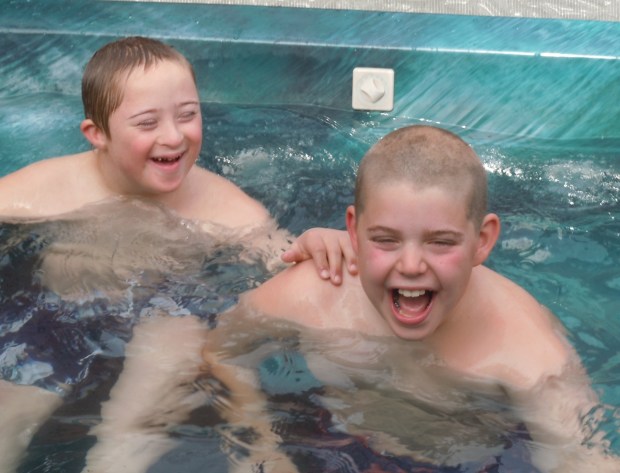
One fall morning in 2000, I received a distress call from my wife who was expecting our first child. A “genetic counselor” had called with the news that a genetic test confirmed that our unborn baby had Down Syndrome. One extra chromosome sent our future into a hard left turn … across traffic … on two wheels … with its eyes closed.

I reacted by sitting silently, freaking out on the inside and wondering just how much our lives would change, or, more accurately, how what we expected life to be like as parents would change. Given the instinctual options of fight or flight, I chose fight. And to be effective I had to know my enemy… so I Googled it.

In hindsight, we feel very fortunate that we knew before he was born. We read all that we could, talked to other parents who went through what we were facing, and we were able to prepare ourselves. Equally important, we were able to prepare our family and friends, so no awkward silences when people visited us in the hospital, no “mongoloid” references from old Aunt Gert, and no grief. It was just as birth should be, filled with joy and celebration.

boys in hot tub

Baby #2

Benno came along 30 months later. We didn’t feel the need for genetic testing during that pregnancy. We had only one hope, that he would be healthy, and we felt fortunate that he was born healthy and “normal.” We settled into a fairly comfortable routine.

Warning: Never get too comfortable! It wasn’t long before both boys were diagnosed with autism. Now Mr. Future was in a barrel roll heading for the wall. Over the years, Ben’s list of diagnoses has expanded to include ADD, trichotillomania, and OCD (I know I’m forgetting one or two).  The one that is dominant changes from year to year, month to month, even hour to hour some days.

It’s a daily struggle for them and us, just like it is for every person and family living in the special needs world. Not only do we all deal with the boys’ various limitations, but we also deal with the limited understanding and acceptance of others. That said, things are much better today than they were in the past, when children with disabilities were hidden from the public or, worse, confined in institutions.

The Bright Side

The good news is that today every person, regardless of perceived capabilities, can achieve the unexpected and contribute to society in meaningful ways. By bringing those with the needs and desires, but not the capability, together with those with the capability and the desire to help, perceptions shift toward every person’s unique value, instead of their relative abilities.

This blog is my contribution to that effort. With every post I will share inspiring stories about people with special needs and those who give from their heart, mind and soul to make life better for them. My hope is that “Special Ops” will educate the uneducated, inspire the uninspired, and in some way contribute to the eventual death of “normal” as an adjective.

Follow Along

To stay up to date with the latest and greatest, you can subscribe to the blog by clicking the Follow box at the bottom of the right-hand column on this page, like the “Special Ops” Facebook page (https://www.facebook.com/specialopstories/), or follow the blog on Twitter (@specialopstory).

Thanks for reading. I look forward to sharing this journey with you.

About me: I am Pete Resler, a dad of two boys with special needs. I created thishead and shoulders blog to tell stories of incredibly good people, including those with special needs and those who give of themselves to make life better for them. My hope is that these stories expose more people to what’s good in the special needs world and inspire them to give of themselves to make life better for those with special needs.
You can help:  I’m always looking for new ideas. If you know someone you think should be featured, shoot me a note at specialopstories@gmail.com.