blindness

Blind to Limits

On any given day, you might find Daniel Stickney surfing or scuba diving in the Pacific Ocean, participating in his college’s student government, or assisting engineers to make technology more accessible. He’s traveled the world and learned new languages. You could say the 22-year-old has a great life, that he holds the world in his hands.

The fact that he can hold anything in his hands is little short of a miracle, considering that shortly after his birth the doctors told Danny’s parents that he had cerebral palsy and would likely live his life in a fetal position.

“Daniel is a gift from God,” says his father, Dyer, a single parent who made it his mission to do whatever he could to help Danny live as independent a life as possible. Finding little help close to home, Dyer expanded that mission to other parts of the world in search of therapies that would prove the doctors wrong. Thanks to intense physical therapy at a young age, Danny is able to use his hands well enough to do many things others with his disability can’t.

Yes, I’m disabled, and…

Danny’s disabilities are merely conditions, hardly limitations. When I first sat down to talk with him and his older brother, Stanford, I asked Danny to tell me about his disabilities. He told me that he is legally blind due to cortical visual impairment, which limits his vision to a periodic sliver from the edge of his right eye.

I expected him to talk about his CP, so I prompted him for more. I got silence.

Stanford explained that Danny was raised without awareness of his disabilities. It wasn’t something he paid attention to until fairly recently. Stanford explained that their father refused to let any of the children’s limitations prevent them from participating fully in life. The focus is always on what each member of the family can do, not what they can’t. Never why, always why not.

Stanford then prompted Danny to talk about his CP, and Danny spoke briefly about his use of a wheelchair. He quickly shifted the conversation to how much he enjoys speaking with people in retirement homes to help them make their own transition to using a wheelchair. The more I tried to get him to talk about himself, the more he talked about how he loves helping others.

Danny is also a “big man on campus” at the College of Adaptive Arts in San Jose, where he takes classes and is vice president of the student government. When he’s not in school, he gives a lot of his time volunteering with various organizations. He is currently a board member for the California chapter of TASH, a disability advocacy organization, and was a featured speaker at its 2015 national conference.
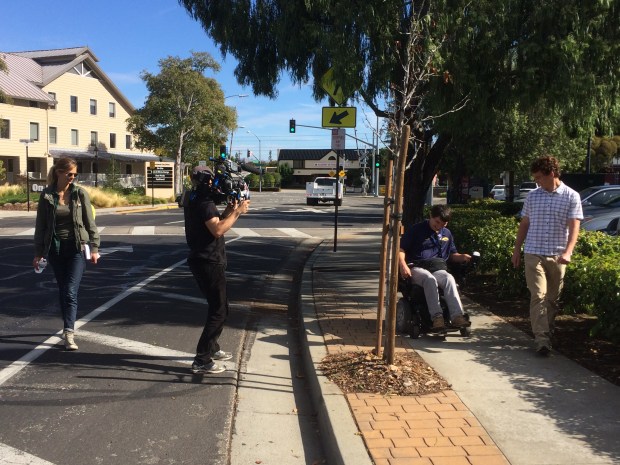
danny-filming

Danny navigates a sidewalk in Los Gatos, CA, during filming of “A Day with Danny” for the Google Accessibility Team.

Shaping tech access

Like any “millennial,” Danny loves technology. He and Stanford had the opportunity to hear Charles Chen of the Google Accessibility Team speak at the Vista Center Blind Expo in Palo Alto, CA, about the work the team was doing to make technology accessible to everyone. They chatted with Charles afterward and soon were meeting with the team and testing a variety of equipment and applications designed to help the visually impaired and people with limited or no fine motor skills access technology.

Danny was also featured in a Google Accessibility documentary called “A Day With Danny,” which was used internally and to promote the company’s Google Impact Challenge: Disabilities program, through which it is donating $20 million to 29 non-profits that are using technology to address a variety of accessibility challenges.

A better wheelchair

This summer I spent an afternoon at Danny’s home in Los Gatos, CA, to observe what Danny called a “Makeathon.” A group of young engineers and creative problem solvers lived with Danny and his family for a week to observe him and develop ways to help him in his daily life.
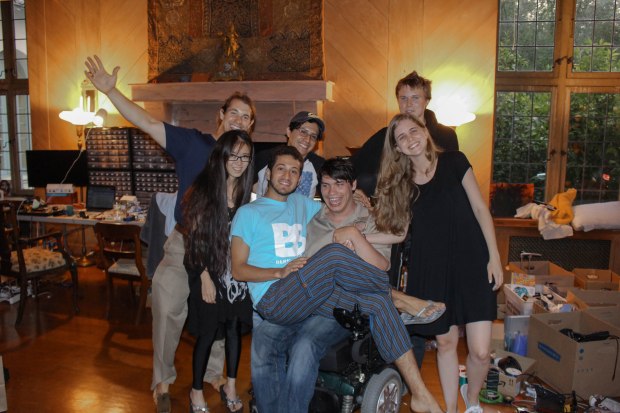
makeathon-group

Danny and his brother, Stanford (back row, left), take a break for a group photo with the “Makeathon” engineers.

By the time the group departed, Danny had a wheelchair equipped with infrared sensors that alert him to obstacles and dangers as he moves about. The engineers used existing technology to design a new type of detection system that alerts Danny when he nears stairs or other potential dangers. They will share what they learned in the open-source community in hopes that others will take their information and adapt it to solve other problems.

Two of the engineers, Stephanie Valencia and Tomas Vega, are co-founders of Assistive Labs, a “global team of dreamers and doers” working to “increase access to assistive devices for people living with disabilities in global markets by collaboratively building adapted and affordable devices” in the areas of health, education, communication, and mobility.

(I will be writing specifically about the “Makeathon” and Assistive Labs in a separate post, so stay tuned. And I hope to include video of me driving an early version of Danny’s retrofitted wheel chair. Too funny to miss!)

What’s next?

Danny views his future as limitless. He wants to continue his advocacy work for people with disabilities, particularly those who are visually impaired or who use a wheelchair. “I love to be involved in the community,” he says. “When I get a chance to help people with disabilities, I try to make life better for them.”

“I want to make it clear that even though I’m in a wheelchair I’m still a human being,” he says. “Anything I think I can do, I can do.”
Unique Vision

Little Earl Rivard wasn’t expected to survive. The 4-month-old had been in a coma for a week after the vehicle in which he rode was hit by a drunk driver. He would awaken and he would live, but the damage was irreversible. Fortunately for Earl, now an adult, he was too young to have memories of the accident or what it was like to see.

Today his students don’t care that he is blind. To them, he is a caring, talented teacher who helps them read, helps them sing, and helps them achieve what others assumed they would never achieve. Like Earl, his students have unique abilities. And, like Earl, they want to make the most of those abilities and do what they love.

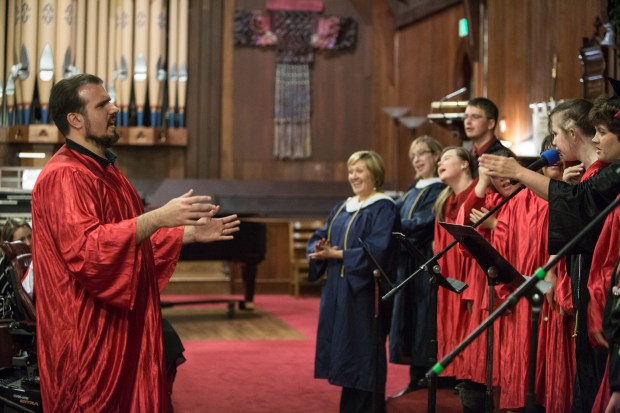
Rivard_chorus

Earl Rivard leads the College of Adaptive Arts concert choir during the 2015 graduation ceremony. (Photo by Linda Krakow Eaman)

Sheltered success

Earl grew up like most other kids. He attended a public school that had a program for blind students in a nearby community, attending regular classes and getting help with adaptive skills such as Braille. He was very active in drama and music, and even played some sports. He excelled academically and attended the University of California – Berkeley, graduating in 2001.

As he grew, he learned what he needed to get along, and he was provided various required accommodations in the classroom to insure he had the same access to education as his peers. But, as an adult, he found that the real world wasn’t so accommodating. “The road got a lot bumpier after college,” he says. “I really didn’t have a sense of what it’s like going through life with a disability, without the supports I had growing up.”

He tried to find work, but he soon learned that his ethnic studies degree wasn’t going to put food on the table. He had crossed the stage at UC – Berkeley graduation and hit a wall. He had to find a way to make a living, a way that minimized or negated his disability. Music seemed to be the logical choice.

Breaking through

“Music was always in the background of my life,” Earl says. His father played the guitar and had a collection of vinyl LPs that provided the soundtrack.

At 14, his family moved to Argentina, his mother’s homeland, for a year. Music is a rich part of that culture, he says, and the spontaneous, participative playing and singing sparked his passion. He’d always enjoyed singing, but something changed for him there. “It was during that year that I found the joy of performance,” he says.

Back in California, Earl got involved in high school musical theater and taught himself to play guitar. In college he sang in an acapella group. So when he had to find a way to put food on the table, he grabbed his guitar and started stumping for gigs.

He did well, performing often and recording three solo albums (“Troubadour Blue” and “Underground Railroad” are available online), collaborating on several others. He’s written some of his own songs and co-wrote others with his father. “My dad is really the songwriter in our family, and many of the songs I have recorded are his.”

While he enjoyed his chosen career, it was physically and emotionally draining. “I love performing for people,” he says, “but I never knew where the next gig would come from.”

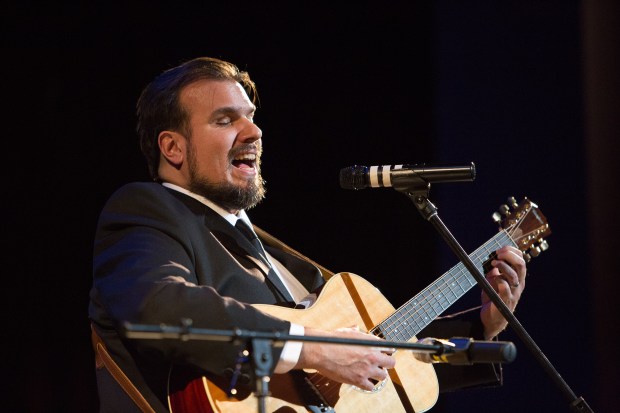
Earl Rivard - CAA performance

Rivard’s love of performance shines on stage and inspires his students. (Photo by Linda Krakow Eaman)

Spreading his wings

Little did he know that his next gig would take him down a very different path. His scheduled had slowed enough that he agreed to help produce a musical program at a day program for disabled adults called Futures Explored in Lafayette, CA, where a friend was working.

It worked out so well that they asked him to teach a music class. It quickly grew from once a week to several days a week and suddenly he was a teacher. “It was the closest thing I’d ever had to a real day job,” he says with a chuckle. “I found real joy working with these special people.”

He also got married and moved to San Jose, adding a lengthy work commute to his daily schedule. It quickly became apparent that he no longer had time for performing, so he put that chapter of his life on hold.

He also started looking for a teaching opportunity closer to home and found The College of Adaptive Arts (CAA), an innovative school where adults with disabilities can explore and learn a variety of artistic and educational disciplines, much like a traditional college. (Read my blog about CAA here.)

“It’s very joyful, very rewarding, and very surprising,” he says. “I love what a supportive environment CAA provides,” says Earl. “It’s a deeply human place.”

Earl leads the concert choir and teaches Music Appreciation. He also assists with a variety of other courses and program, such as music recording, poetry, public speaking, and the student council.

“We’re going to ask you to spread your wings and grow, but we meet you where you are,” he says, offering the Reading Partners class as an example. “The students read to one another based on their level. One person might read three paragraphs, while another might read five words. Regardless of their ability, we always ask them to do a little bit more each time, and we celebrate their success.”

“I get profound joy and satisfaction teaching people where they are and celebrating their accomplishments.”

Rivard_showcase

Rivard performs during a CAA Staff Showcase. (Photo by Linda Krakow Eaman)

Once a performer…

While Earl loves sharing his passion for learning and music with his students, he is still drawn to the stage. He hopes to return to performing; he just needs to figure out how he can fit it into his life again.

He loves the troubadour style of musical storytelling, just a man and his guitar. “It creates a beautiful give and take with your audience.”

“My dream would be to find a way to reach a large audience with the interweaving of storytelling and music. I trust that at some point it will come together.”

head and shoulders

About me: I am Pete Resler, a dad of two boys with special needs. I created this blog to tell stories of exceptional people, including those with special needs and those who give of themselves to make life better for them. My hope is that these stories expose more people to what’s good in the special needs world and inspire them to give of themselves to make life better for those with special needs.

You can help:  I’m always looking for new ideas. If you know someone you think should be featured, shoot me a note at specialopstories@gmail.com.