ASD

Instinct to Serve: CCI Dogs Transform Special Lives

Jacob and Yerba are best friends. When they met three years ago, Yerba was immediately drawn to Jacob. Jacob knew it, too, when Yerba rolled on her back and licked his face.

As I’m sure you’ve guessed, Yerba and Jacob are no ordinary couple. Jacob is a 14-year-old boy living with autism and cerebral palsy and Yerba is a yellow Labrador retriever carefully bred and trained to help Jacob navigate the life that is often so scary and confusing for him.

CCI_family

CCI skilled companion dog Yerba licks Jacob’s ear as they snuggle with Jacob’s mom, Candice, at home.

Their story began in 2012 when Jacob and his mother, Candice, went to a local park. There they met a young girl with Down syndrome and autism who had a “skilled companion” dog provided free by Canine Companions for Independence (CCI).

After researching CCI, Candice applied for a dog for Jacob, hoping it would help him with his anxiety and other social challenges. Nearly two years later, Jacob and Yerba met and their friendship has made an amazing difference for Jacob.

“He’s gained so much independence since he got her,” says Candice. “She knows her role and can sense when he needs her.”

Navigating life together

Jacob transitioned from elementary to middle school just a few weeks after he got Yerba. Stressful for even the most socially skilled 11-year-old, the move was scary and intimidating for Jacob. With Yerba at his side he was able to integrate much more easily. “After the first week, the other kids knew Jacob and Yerba by name,” says Candice, noting that people are curious about Yerba, who wears a special vest. Jacob has learned to answer strangers’ questions about her, building his confidence.

That extra attention can, however, be too much for him at times. Candice recalled a reunion with the person who raised Yerba as a puppy. The gathering with multiple dogs drew a crowd, and Jacob immediately became anxious and withdrew. Yerba sensed his anxiety and instinctively went to him, calming him and shielding him from the crowd.

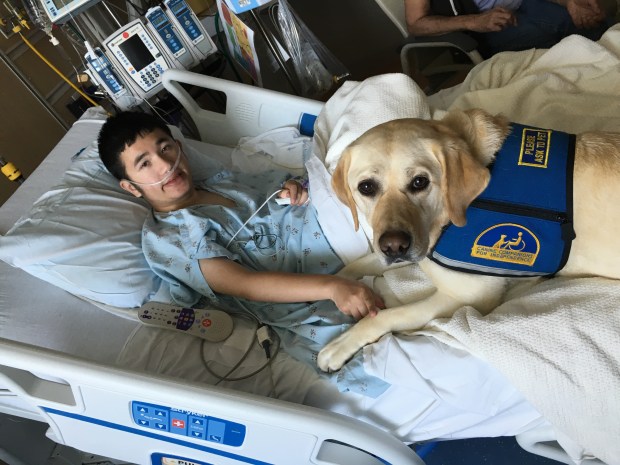
She also recalled how helpful Yerba was when Jacob was hospitalized for pneumonia. Jacob’s grandmother brought Yerba along to the hospital when she visited him, keeping him calm so he could use his energy to heal. “He sits next to Yerba and puts his hand on her. It really calms him,” says Candice.
Yerba_hospital_CCI

Yerba is always there for Jacob, even when he must be hospitalized for pneumonia.

Power to help

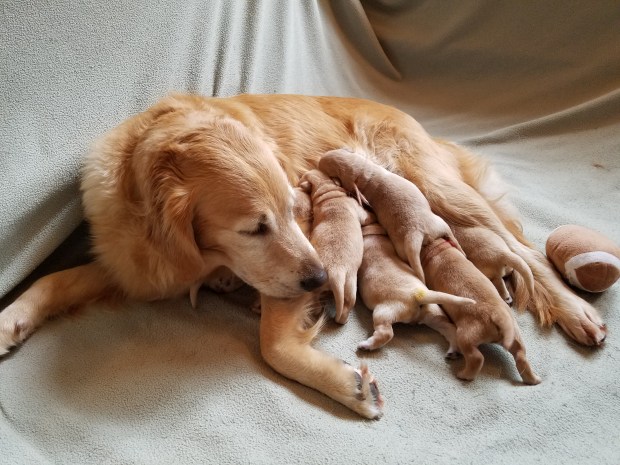
I was introduced to the CCI way by Sharon Mosbaugh, a volunteer “breeder caretaker” in Danville, CA. Sharon takes care of Salinas, a female breeder dog, and tends her litters. Sharon introduced me to Salinas and her litter of five pups, just days old. Sharon cares for them for their first eight weeks, when they are sent to volunteer “puppy raisers” who provide care and socialization and teach them basic obedience skills for the next 16-18 months.

I got to hold one of the tiny pups and couldn’t understand how Sharon could care for litter after litter and then let them all go. “How can I not give them up?” she asked. “When you see the power they have to help others, it’s really magical.”

At 18-20 months, the young dogs are sent to one of six regional training centers across the U.S. where they receive extensive training to serve in one of four specialized roles:

  • Service dogs, who assist adults with disabilities by performing daily tasks
  • Hearing dogs, who alert their partners, who are deaf or hard of hearing, to important sounds
  • Facility dogs, who work with clients with special needs at places such as schools, court houses, and hospitals, and
  • Skilled companions, like Yerba, who enhance independence for children and adults with physical, cognitive, and developmental disabilities
Salinas_litter_CCI

CCI breeder dog Salinas quietly nurses her pups just days after they were born in the home of breeder caretaker Sharon Mosbaugh.

Science and service meet at CCI

Sharon explained that breeder dogs, like Salinas, are the best of the best in terms of temperament and other traits required to provide the services clients require. All breeding occurs within 90 miles of CCI headquarters in Santa Rosa, CA, to maintain the control and consistency so important to the process.

Since its beginnings in 1975, CCI has placed more than 5,000 dogs across the U.S. Many more have been born into the program, but not all are cut out for the work ahead. “They won’t send a dog out to work unless they are absolutely certain of what it will do,” says Sharon.

She says that CCI is closely involved in every stage of the dog’s life to be certain it receives quality care and provides quality service. When a dog is retired, CCI places it with a loving owner and the client may apply for another dog.

CCI’s scientific approach attracts premier researchers who team with CCI to learn about the traits that make CCI dogs special. The organization is working with a consortium of canine research centers from Emory University, Georgia Tech, the University of California at Berkeley, and Dog Star Technologies on a study focused on the reward center of the canine brain.

Canine Companions Puppy

A CCI pup learns the basics with a puppy raiser before moving on to specialized training. (CCI photo)

The dogs just know

One of the most special traits of the CCI dogs is their sense for who needs help. “I’ve watched it work,” says Sharon, who worked with service dogs as a school administrator in Indiana and California.

She told the story of a young student in Indiana who was traumatized by the death of a teacher and a family member in a short span of time. He refused to return to school. When his parents finally got him to the campus, he refused to go in.

Sharon met him at the car with the school’s facility dog, Sally. The dog went to the boy and put her paw on his arm. He soon calmed down and agreed to take Sally for a walk around campus. He decided to stay.

“People have no idea how profoundly the dog will change their lives,” she says. “They were my secret teaching weapon.”

Get a dog or get involved

The CCI website is loaded with great information for people interested in getting a dog or volunteering in some capacity.

If you think you might be interested in a dog, check out this helpful page to determine if a service dog is right for you. CCI receives more applications than it has dogs available, so only the people who will benefit most will be considered.

CCI can’t do what it does without a large team of dedicated volunteers. If you would like to volunteer or help CCI in other ways, here are some ideas.

If you do get involved, I’d love to hear and share your stories of how these amazing dogs are changing lives.

This is a Test: The Inner Struggles of a Special Needs Parent

On the day we found out that Christian would be born with Down syndrome, family and close friends tried to make us feel better by telling us, “God only gives you what he knows you can handle.” Their intentions were pure, but I couldn’t help but feel that diagnosis was more of a punishment than a gift. I’m not proud of that, but it’s the truth.

It was 16 years ago, but I can still vividly remember sitting with Sarah while a genetic counselor at a large Catholic university hospital near Chicago explained what was known at that time about the physical and mental effects of trisomy 21, the medical name for Down syndrome. She made it clear that those effects can manifest themselves in mild to severe ways, but there were some certainties that we thought would change everything.

The counselor then presented our options. Options?!? The soft spoken lady at the Catholic hospital told us we could have the baby and either keep it or give it up for adoption, or terminate the pregnancy.

I would have never considered termination, but she mentioned it and it made me think very briefly about it and, more importantly, why we wanted to have a child. It wasn’t because we expected to have the perfect child. It was because we loved one another and wanted to have, raise and love a child together. We had made that decision several months earlier and no other decision was necessary.

As certain as that sounds, we were both very shaken and disoriented by the news. The script of our lives had been altered and we had no idea what that meant.

Now what?

Over the next several weeks we mourned the loss of the “normal” child we had been preparing for. We continued on with the things that still had to be done, such as preparing the baby’s room, picking names, attending baby showers, and so on. We did a lot of research and talked to lots of people to try to fill in the blanks about the future, and then we waited to see what would happen.

The pregnancy grew complicated and Christian was born four weeks early by emergency C-section. He was only five pounds, but he and Sarah both came through it fine. He had none of the heart deformities or other physical issues that occur more frequently in Down’s kids. We felt fortunate.

We began weekly treks to Easter Seals when he was just six weeks old, hoping the therapeutic interventions would help with his development. He hit all of his milestones, just later than typical kids, and he was happy and healthy. We adjusted to our new life.

beach-122406

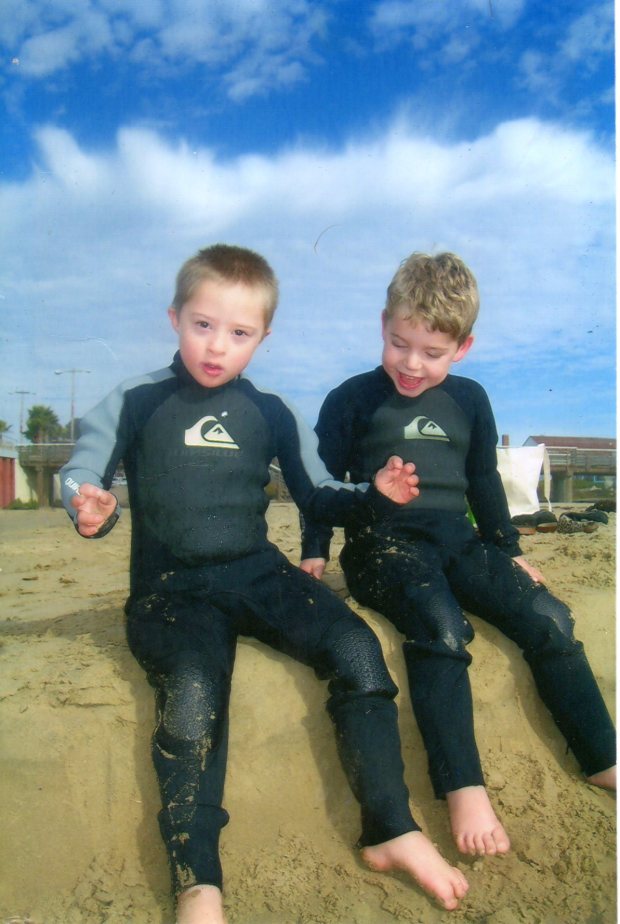
Christian and Ben, Pismo Beach, CA, 2007

A little ‘normal’

A couple years later Sarah was pregnant again. We refused the genetic testing this time. Our life plan had become a daily plan, so we were OK with whatever God gave us. Benno was born following a normal, uncomplicated pregnancy. He was healthy. He had the normal number of chromosomes. This was how we had imagined it would be; you know, normal.

Within a few years, he began showing some signs of autism, nothing in the “Rain Man” realm, just some behavioral anomalies that caught our attention. He was evaluated and the diagnosis was confirmed. Not so normal after all.

Friends told us that God must really have faith in us as parents to give us two special children.

Apparently the almighty’s faith in us was immense, because it wasn’t long before Christian was evaluated and also diagnosed with autism. And Ben has ongoing struggles with anxiety, obsessive-compulsive disorder (OCD), and impulse control challenges.

And they’re both fully infected with puberty.

Other than that, things are normal.

Why us?

Ever since that day we met with the genetic counselor, I’ve frequently wondered why this was happening to us. Were Sarah and I being punished for something? Were our children being punished? What did we do to deserve this?

I’ve looked at other parents and their typical kids and wondered why this happened to us instead of them. What was so special, or awful, about us for this to happen?

I feel guilty, petty and selfish because of these thoughts, but I still have them sometimes, especially on the more challenging days.

Every time I’m embarrassed by their behavior in public, every time I get frustrated because they can’t understand or process what I tell them, every time I lose my cool and snap at them, I feel like a failure. Maybe God was wrong about me.

Sarah and I talk about these things a lot. The fact that we still talk at all could mean that God knew what he was doing. The stress of raising special kids has at times torn us apart and at other times brought us together. Many, many marriages don’t survive the challenges of raising a special needs child. Ours has survived that, and three major relocations, two layoffs, and whatever is next.

We are not perfect, but we are certainly determined to prove that God knew what he was doing.

About me: I am Pete Resler, a dad of two boys with specialhead and shouldersneeds. I created this blog to tell stories of exceptional people, including those with special needs and those who give of themselves to make life better for them. My hope is that these stories expose more people to what’s good in the special needs world and inspire them to give of themselves to make life better for those with special needs.

You can help:  I’m always looking for new ideas. If you know someone you think should be featured, shoot me a note at specialopstories@gmail.com.

Unlock My Life

Have you ever been annoyed when you have to send an important message to someone and your computer is acting up? Or your cell battery dies just when you need to send an important text? Frustrating, for sure!

So imagine what it must be like for someone waiting more than 20 years to communicate his needs, feelings and thoughts, locked inside his mind by a faulty connection between his brain and body.

The disconnect is still there, but the lock is now open. Chris Dodd can’t use his voice, but his words are clear, expressive, and intelligent.

Chris and Masai conference dinner

Masai and Chris

The Wrong Key

As a child, doctors diagnosed Chris with global developmental delay, or delays in several different areas. He could not speak and had poor control of his physical movement, manifested similarly to cerebral palsy. He was given little hope of communicating beyond the sounds and movements that indicate basic needs, and no one really knew his level of intelligence.

He was enrolled in various programs such as AchieveKids, which teaches non-verbal children to communicate using pictures, but had limited success. As he grew physically, so did his isolation and his understanding that he was different. “It was sad because I was teased a lot,” Chris told me, “but I had my family and friends.” He took anti-anxiety medication to help ease the stress.

In his early 20s, Chris went to see a different neurologist, who told Chris’s mother, Kim, that he clearly has autism. “We were very surprised,” said Kim. “It was the first time anyone had ever made that diagnosis and it changed the way we thought about how we could help him.”

Shortly before his 21st birthday, Chris moved into his own apartment. “I needed my own place,” he said. “It was time to leave the nest.” His family’s home had grown very busy and was a bit overwhelming for him. His first live-in caregiver was a family friend, who made it easier for Chris to make the transition into a quieter apartment that better met his sensory needs.

The Right Key

When Chris was in his mid-20s, Kim, who is the founder and executive director of Trinity CHANGE, Inc., a supported living services agency in San Jose, CA, discovered the key to unlock Chris’s communication during a meeting with a non-verbal client. He used a technique called supported typing to communicate, and Kim hired an expert to teach the technique to Chris and his caregivers.

By the end of the first session he was communicating… for the first time in his life!

I interviewed Chris at his apartment and, as a father of autistic kids, I was surprised by the difficulty he had controlling his movements. Kim explained that Chris has a “disorganized body” as the result of his autism. Basically, that means there is a lot of static in the connection between his brain and his body. When his brain sends a signal for his body to move, the message is garbled and his body can’t always do what he wants.

Turning the Key

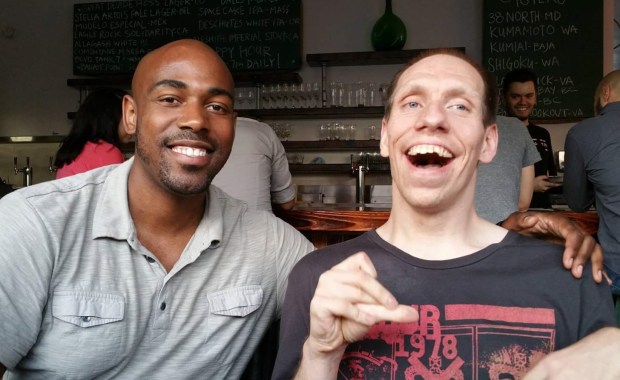
He needs physical touch to “organize” his body, explained Kim, meaning he needs someone to apply a bit of pressure so he can better control his movements. During the interview, Masai Davis, Chris’s primary live-in caregiver, sat next to Chris, who sat in front of his type pad, a laminated page with the alphabet, propped up on a small easel. After each question, Masai would lightly hold Chris’s right arm as Chris attempted to touch the letters to form his words. That pressure helped Chris target the letter more accurately, but it was often still a struggle.

Masai, who has worked with Chris for nearly five years, gently provided physical and verbal support when Chris lost focus or control. Sometimes it took several minutes for him to complete a word. Knowing how long it took Chris to share his first words, I was happy to wait.

With his voice unlocked, everything began to change for Chris. As his communication skills grew, so did his world. He soon was off the anti-anxiety medication.

Besides Masai, there are typically 2-4 other caregivers who come in part-time to ensure around-the-clock support for Chris. Finding and keeping good staff is the hardest part about living alone, says Chris. “They don’t get paid much and I get attached to them. I just lost two good staff,” he said. “These days are really rough.”

But when I asked him what he would change, if he had the opportunity, he said, “Nothing. I have a great life.”

About me: I am Pete Resler, a dad of two boys with special needs. I created thishead and shoulders blog to tell stories of incredibly good people, including those with special needs and those who give of themselves to make life better for them. My hope is that these stories expose more people to what’s good in the special needs world and inspire them to give of themselves to make life better for those with special needs.

You can help:  I’m always looking for new ideas. If you know someone you think should be featured, shoot me a note at specialopstories@gmail.com.