Michael Criscione was destined to contribute to society as a vending machine attendant, or at least that’s what a government bureaucrat thought he should do. And maybe for others living with spinal muscular atrophy (SMA) that would be just fine, but Michael is not typical.
“I wanted to do something that makes a difference,” said the 33-year-old when we met in Lafayette, CA, to chat and have a beer.
Allow me to put the scene in perspective: When I said we enjoyed a beer, we did, just in our own ways. I drank mine the usual way, while Michael’s attendant poured his directly into his stomach via a port in his abdomen.
Body breakdown
You see, Michael can’t swallow because the muscles that control that process no longer function properly, much like most of the voluntary muscles in his body, including those that help him breathe. SMA is a genetic disorder that results in muscular deterioration and impaired mobility. Michael has Type 2; Type 1 is the most severe. It is a progressive disorder that cripples more and more over time.
He’s in a wheel chair, his movement is very limited, and he has difficulty speaking clearly. His attendant, Christian, had to interpret much of what he said during our discussion. A BiPAP machine aids his breathing. Despite his physical limitations, Michael lives in his own place, but he does require assistance 24/7.
While his body is greatly affected, his brain and his motivation are fully functional. So when the bureaucrat pressed him to do the vending machine work, it’s understandable why Michael felt insulted.
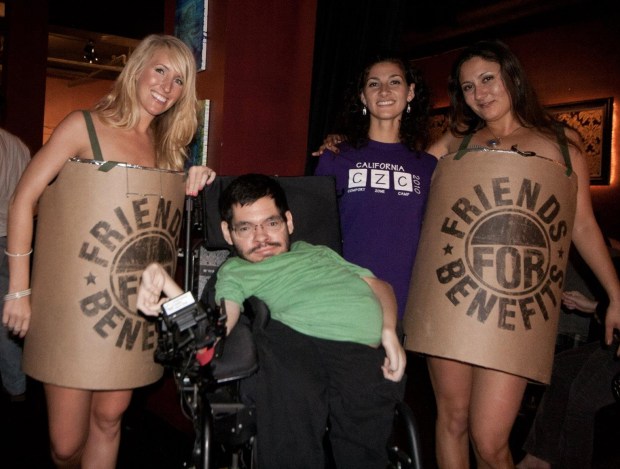
Michael Criscione, flanked by Friends for Benefits Barrel Girls Savannah Gray (left) and Pilar Fox, with friend Kim Masdeo
Making his own way
After finishing high school, Michael studied film at the University of California at Berkeley. During that time he started an indie rock band called the Pied Paupers with some of his attendants who were musicians. Michael was the manager, booking shows and getting them some local radio play.
He took his first job as head of fundraising for a non-profit run by a high school friend. He tapped his music network to begin producing concerts for the charity, but the organization eventually folded.
He took that experience and started Friends for Benefits, a non-profit that helps other non-profits by producing fundraising events primarily in the San Francisco Bay area. “I found that most non-profits are great at whatever their mission is, but most of them have no idea how to fundraise,” he said. “There is definitely a need for what I’m doing.”
Since his first music benefit event under Friends for Benefits in 2012, he has organized more than 10 events, more recently focusing on other different genres that bring in more money for the charities. Michael is the organizer, and others help with the details, such as event operations and finance.
With a fully charged wheelchair and an attendant at his side, Michael is constantly prospecting for future events by meeting entertainers and other celebrities at public events around the Bay area, such as shows, fan conventions, and book signings.
Bigger and better
In January, comedian and character actor David Cross (Tobias Fünke on “Arrested Development”) performed his “Making America Great Again” stand-up show at Davies Symphony Hall in San Francisco. Cross generously donated a portion of the proceeds from the evening to Friends for Benefits.
The next event will be “Call Me Lucky: An Evening with Bobcat Goldthwait” (yes, children of the ’80s, that Bobcat Goldthwait) on May 27, 2016, at the Roxie Theater in San Francisco. It will be a screening of “Call Me Lucky”, a documentary directed by Goldthwait about comedian Barry Crimmins, followed by a Q&A.
“We’re not fully established yet,” said Michael, “but we’re doing bigger and better things.” Several other events are being planned, but his dream is to create a week-long arts festival, with a variety of events benefitting several charities. “I want to get Friends for Benefits to a point where we are doing measurable good and I can be fully independent, with no assistance from the government.”
And how likely would that be if he was looking after vending machines?
About me: I am Pete Resler, a dad of two boys with special needs. I created this blog t o tell stories of incredibly good people, including those with special needs and those who give of themselves to make life better for them. My hope is that these stories expose more people to what’s good in the special needs world and inspire them to give of themselves to make life better for those with special needs.
You can help: I’m always looking for new ideas. If you know someone you think should be featured, shoot me a note at specialopstories@gmail.com.
 blog to tell stories of incredibly good people, including those with special needs and those who give of themselves to make life better for them. My hope is that these stories expose more people to what’s good in the special needs world and inspire them to give of themselves to make life better for those with special needs.
 Special Ops