“I found I could say things with color and shapes that I couldn’t say any other way – things I had no words for.” – Georgia O’Keeffe
Artists have a special gift that often lies dormant until someone provides encouragement and opportunity, allowing it to fully blossom. Be it painting, dancing, writing or film-making, creativity needs inspiration and an outlet to release expression, regardless of a person’s physical voice.
DeAnna Pursai and Pam Lindsay have opened that door for adults with disabilities by founding the College of Adaptive Arts (CAA) in San Jose, CA. There students have a unique opportunity to express themselves like they never could before thanks to a dedicated team of professionals who are building a true college experience for people who don’t have a place in a traditional college classroom.
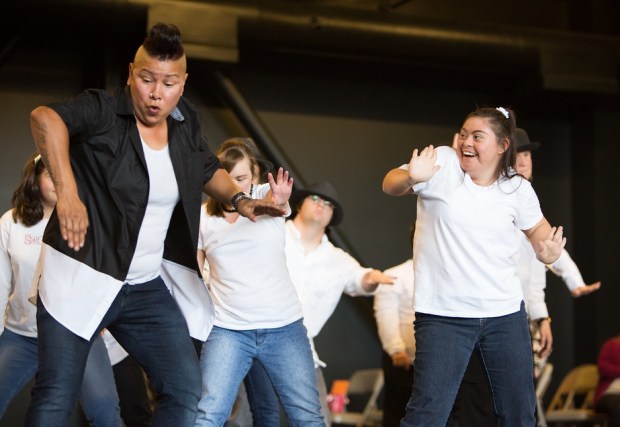
Professor Isabella Torres and dance student Renee show their hip-hop moves during the 2015 graduation ceremony. Photo courtesy of Linda Krakow Eaman.
A Better Option
“When people age out of the special education system as young adults, there aren’t many programs for them,” said DeAnna, who serves as executive director and is a public school teacher. “We wanted to provide an environment where they can explore and expand their abilities, not sit in a day program for the rest of their lives because of their disabilities.”
She hatched the idea while running a non-profit theater program for children with disabilities, called Angels on Stage, named for her sister, Angel, who has Down syndrome and acted in a similar troupe as a child in Indiana.
There she met Pam, whose daughter performed with the troupe. With a professional background in acting and other performing arts, she began directing the troupe. She soon saw the need for a similar program for disabled adults and began running an acting workshop for them.
Pam had also been homeschooling her daughter, Val, using theater and music to help Val learn, and was also completing a master’s degree in theater arts with a focus on how techniques used in teaching character acting can be effective in teaching social cognitive skills to autistic children.
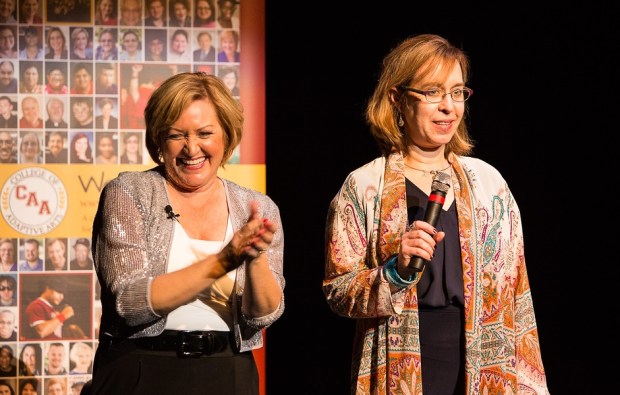
CAA co-founders Pam Lindsay and DeAnna Pursai. Photo courtesy of Linda Krakow Eaman.
Going Live
With DeAnna’s experience in special education (she still teaches part-time) and running a non-profit, and Pam’s arts and education expertise, they launched CAA in 2009, renting a small space at a dance studio for their first 12 students. Seven years in, CAA has moved around a bit as discounted spaces are lost and new ones found, all the while growing to more than 70 students today.
They enjoy eight different courses of study, learning dance, vocal and instrumental performance, TV and film production, fine arts, and a variety of other courses in the arts and other educational disciplines and life skills.
And like traditional universities, CAA offers low-cost bachelor’s and master’s degree tracks in each discipline. The standards and accreditation are unique to CAA, but that fits its unique community perfectly. And so does the staff, more than half of whom also have a disability.
Life is a Stage
Performers and artists learn their craft in the classroom, then, like other professionals, take to the public stage, screen and gallery to share their art with the masses. Performance groups, such as the graduate theater troupe, perform for local children, while TV and film students produce a TV show and debut their short films at the annual Celebrating Differing Abilities Film Festival.
Several aspiring actors even had the opportunity to participate in a professional-style audition before some of the top professionals in Bay Area theater through a partnership with City Lights Theater in San Jose. Students experienced it all, from preparing their resumes, complete with professional photos, to rehearsing, performing and receiving feedback from the panel.
“It was really a great experience for the students to feel the pressure and excitement of a real audition,” said Pam. “But it was also a real revelation for the professional judges, who now view our actors as legitimate members of the theater community.”
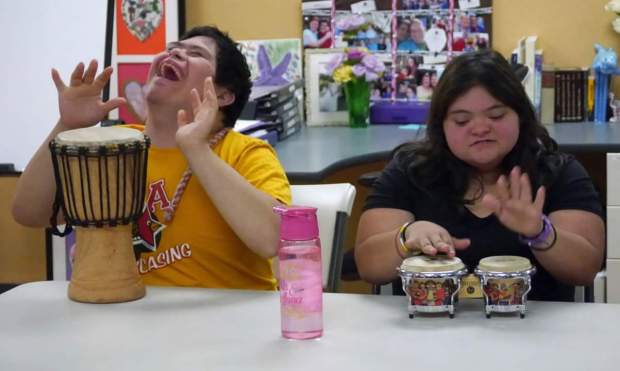
Carlos and Nathalie keep the rhythm during one of many music classes at CAA.
Student Ambassadors
When it comes to selling the school, the students are the secret sauce. “Every time someone tours the college or the students go out and perform, we win at least one more heart,” said DeAnna. “We’re not a day care; our students want to be here to learn, create and contribute, and it shows in their enthusiasm.”
When it came time to find the space the college now occupies, it was a student who sold the property owner on providing the space at a discount. But with that discount comes the possibility that CAA will lose that space if someone else is willing to pay full price. “We’ve had times when we’ve lost our space and had to scramble to find places to hold our classes,” she said. “We’re very fortunate and thankful that we have this space, but we are always looking for a permanent place to call home.”
Growing on a Permanent Foundation
Their goal is to find an area college that will welcome CAA as a charter school on campus, providing a permanent home and giving students a real campus where they can utilize more resources and mingle with typical peers.
“Once we have a more permanent location, we’d like to grow into other markets to provide opportunity to adults with disabilities in other parts of the country,” said DeAnna. They have also submitted a grant application to fund the technology they need to provide distance learning for people who are physically unable to get to campus or live in other parts of the world.
Stay Tuned
The story of CAA is rich and evolving, with students, professors and volunteers all working to build a community where adults with special needs can learn, grow and express themselves as they want. It’s all too much to tell in a single post, so stay tuned to Special Ops for more stories of exceptional people at CAA!
About me: I am Pete Resler, a dad of two boys with special needs. I created this blog to tell stories of  incredibly good people, including those with special needs and those who give of themselves to make life better for them. My hope is that these stories expose more people to what’s good in the special needs world and inspire them to give of themselves to make life better for those with special needs.
You can help: I’m always looking for new ideas. If you know someone you think should be featured, shoot me a note at specialopstories@gmail.com.
 o tell stories of incredibly good people, including those with special needs and those who give of themselves to make life better for them. My hope is that these stories expose more people to what’s good in the special needs world and inspire them to give of themselves to make life better for those with special needs.
 Special Ops